Understanding the Potential Scale of the Ebola Outbreak
New York (AP) — A new analysis by U.S. health officials suggests that the current Ebola outbreak in Central Africa could potentially reach up to 20,000 cases or more, depending on how quickly infected individuals are isolated to prevent further spread. The Centers for Disease Control and Prevention (CDC) released a range of scenarios generated by computer models, which include estimates from 10,000 cases to over 20,000.
If these projections are accurate, the worst-case scenario could resemble the 2014-2016 West Africa epidemic, which recorded over 28,000 confirmed cases and more than 11,000 deaths. This comparison highlights the urgency of addressing the current outbreak effectively.
Expert Perspectives on the Modeling
Dr. Satish Pillai, incident manager for the CDC’s Ebola response, emphasized that without strong public health interventions, the modeling work indicates that an outbreak of such scale is possible. Jennifer Nuzzo, director of Brown University’s Pandemic Center, echoed this sentiment, stating that the modeling “affirms what we have worried about since the beginning: This outbreak is following a dangerous trajectory” if more is not done to halt its spread.
However, Nuzzo also cautioned that predicting the progression of outbreaks can be extremely challenging. “I wouldn’t read too much into the specific numbers. It’s really hard to make an accurate projection when you have limited data,” she added.
Current Status of the Outbreak
The Africa Centres for Disease Control and Prevention reported approximately 400 confirmed cases, including 63 deaths. Experts suggest there may be additional cases that remain undiagnosed or unreported.
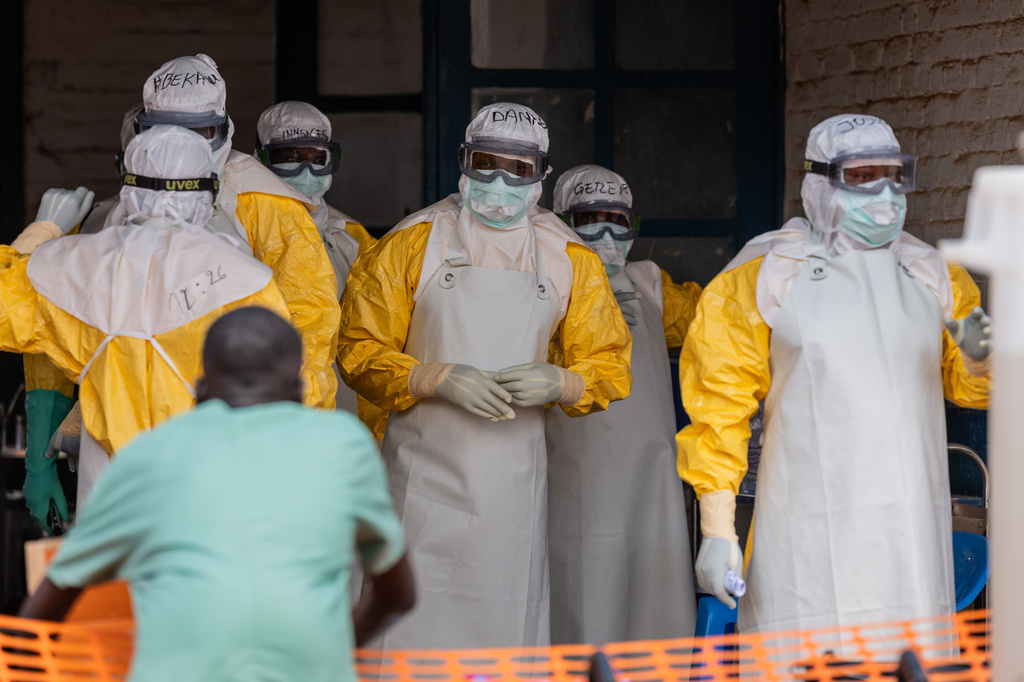
Ebola viruses spread through contact with bodily fluids such as vomit, blood, and semen. There are currently no specific treatments or vaccines available for the Bundibugyo virus, which is at the center of the current outbreak. The disease is often fatal, making containment efforts even more critical.
Global Health Emergency and Challenges
In May, the World Health Organization declared the outbreak a global health emergency. Some experts believe infections may have been occurring as early as February, but health officials initially tested for a different type of Ebola virus.
The response to the outbreak has been complicated by an armed conflict between Congo’s government and the Rwanda-backed M23 rebel group, as well as attacks by the Islamic State-affiliated group the Allied Democratic Force. These conflicts have led to significant displacement of people in affected areas.
Risk Assessment in the United States
Earlier this week, Nuzzo stated that the risk to the United States appears low. “I don’t think it’s a scenario that it’s going to come here and spread broadly,” she told reporters. The CDC echoed this assessment in an article released on Friday.
This assessment is partly due to decisions made by the U.S. government to ban the entry of people without U.S. passports, as well as U.S. green-card holders who visited Congo, Uganda, or South Sudan in the previous 21 days. Additionally, individuals with U.S. passports who traveled to those countries are undergoing health screenings and being directed to four receiving airports.
CDC’s Modeling and Its Implications
The CDC’s modeling report attempts to project potential outcomes based on various factors, including the number of infections and deaths already recorded, and the success of responders in identifying and isolating infected individuals before they can spread the infection to others.
Assuming around 50 deaths and about 20% of infected individuals successfully isolated by late May, most simulations suggest at least 20,000 cases and 4,000 deaths will occur in Africa over three months.
Pillai noted that the actual isolation rate remains unknown but is considered to be “on the lower end of the scenarios” that the CDC modeled.
Higher isolation rates, such as 50% or 70%, could result in fewer cases, estimated at around 10,000. However, if the actual number of deaths in late May was greater than currently recognized, the outcomes could worsen.
Lessons from Past Modeling Efforts
Some CDC modeling during the large Ebola outbreak in West Africa proved to be significantly off. In 2014, the CDC estimated that in a worst-case scenario where nothing was done, as many as 1.4 million people might become infected. This turned out to be more than 50 times higher than the actual number of cases recorded.