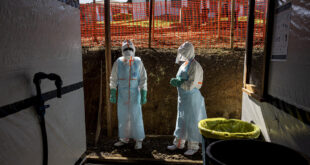
Understanding the Ebola Outbreak in the Democratic Republic of the Congo and Uganda
A recent report from the Centers for Disease Control and Prevention (CDC) has raised concerns about the potential scale of the current Ebola outbreak in the Democratic Republic of the Congo (DRC) and Uganda. The report suggests that, in a worst-case scenario, the outbreak could result in over 20,000 cases and more than 2,000 deaths. This projection is based on data collected up to May 24, when approximately 50 deaths had already been reported.
The situation is particularly alarming because the outbreak is caused by the Bundibugyo strain of Ebola, which currently has no available vaccines or treatments. The model assumes that only 20% of patients isolate themselves, and access to vaccines and treatments is limited. Even in a more optimistic scenario, where around 70% of cases isolate, there is still a one in five chance that the outbreak could surpass 10,000 cases within three months.
Dr. Krutika Kuppalli, an infectious diseases physician at UT Southwestern Medical Center and former World Health Organization medical officer, described the projections as “concerning.” She emphasized that under certain scenarios, the current Bundibugyo Ebola outbreak could grow into one of the largest ever recorded. However, she also noted that the future of this outbreak is still within the control of the international community.
“The findings should serve as a call to action for the international community,” Kuppalli said.
Current Status of the Outbreak
According to the World Health Organization, there have been 397 confirmed cases and 65 deaths in the outbreak. On a call with reporters, Jason Asher, director of the CDC’s Center for Forecasting and Outbreak Analytics, clarified that the modeling is not a forecast but a planning tool. He stressed that the models are built on current data and understanding of conditions, designed to support action rather than generate alarm.
Lawrence Gostin, director of the World Health Organization Collaborating Center for National and Global Health Law, welcomed the CDC’s risk assessment. He pointed out that the CDC had been absent in the current Ebola response, unlike during the 2014-2016 West Africa outbreak, which was the largest on record with over 28,000 cases and 11,000 deaths.
Challenges in Containing the Outbreak
It remains unclear how many Ebola cases are going undetected in the DRC and Uganda. The initial response to the outbreak was hampered because standard Ebola tests did not detect the Bundibugyo strain. Additionally, the epicenter of the outbreak, Ituri province, is a conflict zone, complicating efforts to contain the spread.
Dr. Satish Pillai, who is leading the CDC’s Ebola response, noted that while the situation remains fluid, the percentage of cases being detected and isolated appears to be on the lower end. He emphasized that the report is meant to highlight the need to marshal resources to contain the outbreak.
Risk to the General U.S. Population
A separate CDC report, also published on Friday, found that the risk to the general U.S. population remains low. Dr. Pillai stated that the report was released not because the risk is high, but due to concerns about the outbreak.
To date, no Ebola cases linked to the outbreak have been reported in the U.S. However, Dr. Peter Stafford, an American surgeon who contracted Ebola while working in the DRC, was evacuated to Germany for treatment. His wife and four children, who were exposed to the virus, were also flown to Germany, while another doctor, Patrick LaRochelle, was taken to the Czech Republic for monitoring.